
When executive teams sit down to map out their AI Governance frameworks, the conversation almost inevitably gravitates toward the technology itself. The strategic focus zeroes in on the models: how to prevent hallucinations, how to measure algorithmic drift, and how to detect inherent bias.
This is exactly the narrative being pushed by the rapidly growing market of AI tech vendors and software providers. They are aggressively selling sophisticated dashboards designed to track model behaviour, creating the illusion that monitoring an algorithm is the same as governing it. Treating these technical tools as a complete governance solution is a strategic misstep that is leaving major organisations dangerously exposed.
Recent enterprise research highlights a severe disconnect between widespread AI adoption and operational readiness. Although most organisations now use AI, nearly two-thirds have yet to begin scaling it across the enterprise, making the transition from experimentation to effective deployment a central challenge.
Yet deployment is not merely a technical challenge. As AI systems move into production, organisations must address regulatory compliance, auditability, accountability, data privacy and documented human oversight across the entire AI lifecycle. Model performance remains important, but it represents only one part of a much broader governance problem.
What Really is AI Governance?
Without reliable records, mapped obligations and clear ownership, even technically well-monitored systems can leave the organisation exposed. The EU AI Act requires providers of high-risk AI systems to maintain clear, comprehensive and current technical documentation capable of demonstrating compliance to competent authorities.
While not as structured, the UK follows a regulator-led framework built around safety, transparency, fairness, accountability and redress, with the ICO requiring organisations to demonstrate responsible governance where AI processes personal data. UK companies doing business in the EU may also fall directly within the EU AI Act when they place AI systems on the European market or their systems’ outputs are used there, making EU-grade documentation and auditability essential for continued market access.
Effective AI governance is therefore not solely a model architecture problem. It is also a data provenance, accountability and compliance problem. Leadership teams should reflect this broader reality in their procurement and staffing decisions by building compliance-literate teams and investing in system inventories, documentation, evidence retention and audit capabilities alongside model-monitoring tools.
The objective is not to downgrade model risk, but to create a governance architecture that can both manage system performance and demonstrate that every AI system operates within defined legal and organisational boundaries.
The August 2026 Reality Check
This shift in priorities is not simply best practice. It is becoming a legal and commercial imperative. The EU AI Act is being introduced through a phased timetable. Prohibited practices and AI literacy obligations have applied since February 2025, while general-purpose AI requirements have applied since August 2025. From 2 August 2026, most remaining provisions and enforcement mechanisms are scheduled to apply, although some requirements for high-risk AI systems embedded in regulated products will follow later.
The penalties are substantial, but they vary according to the infringement. Breaches involving prohibited AI practices can attract fines of up to €35 million or 7% of worldwide annual turnover, whichever is higher. Most other operator and transparency violations can attract fines of up to €15 million or 3% of worldwide turnover, while supplying incorrect or misleading information to regulators can result in fines of up to €7.5 million or 1% of turnover. For SMEs, the lower of the fixed amount or the turnover percentage applies, reflecting the requirement that penalties remain proportionate.
Despite this regulatory pressure, corporate readiness remains uneven. IBM’s 2025 research found that 63% of breached organisations either had no formal AI governance policy or were still developing one. Among organisations that experienced an AI-related breach, 97% lacked appropriate AI access controls. These control failures produced measurable consequences, with 60% of AI-related security incidents compromised data, while 31% caused operational disruption.
The governance lesson is clear. Organisations should not wait for a breach or regulatory enquiry before documenting how their AI systems operate. Every production system should have a named business owner, a recorded purpose, a risk classification, an approved data-access profile and a clearly defined human escalation route. Access should follow least-privilege principles, with separate authorisation for sensitive financial, personal, contractual or commercially confidential information.
Regulators will increasingly expect more than sophisticated model-monitoring dashboards. For high-risk systems, the EU AI Act requires automatic event logging to support traceability, post-market monitoring and operational oversight. It also requires documented controls covering training, validation and testing data, including data origin, preparation, suitability, gaps and potential bias.
Beyond Model Monitoring: Five Requirements for Compliance
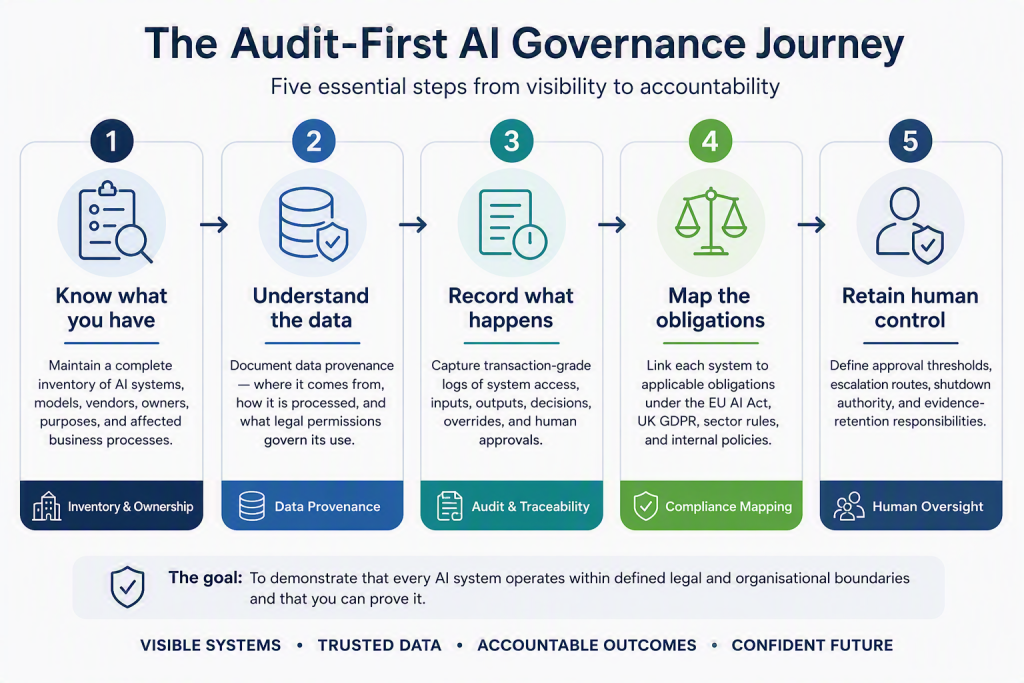
This framework is not a random collection of IT tasks; it follows a strict, sequential logic designed for regulatory defence: know what you have → understand the data → record what happens → map the obligations → retain human control.
- A complete AI inventory: Record every sanctioned AI system, embedded model, third-party vendor, business owner, intended purpose and affected process.
- Data provenance records: Document where training, testing and operational data originated, how they were processed, and what legal permissions govern their use.
- Transaction-grade logs: Capture system access, material inputs and outputs, automated decisions, human overrides and formal approvals.
- Regulatory mapping: Link each system to its applicable obligations under the EU AI Act, UK GDPR, relevant sector rules and internal policies.
- Human oversight and incident procedures: Define approval thresholds, escalation routes, intervention rights, shutdown authority and evidence-retention responsibilities.
The objective is not simply to prove that a model performs well. It is to demonstrate that the organisation knows which AI systems it operates, what data they use, who controls them and whether every material action remains within defined legal and organisational boundaries.
The Leadership Imperative: Re-architecting AI Governance
At Northstar Consulting, we advise clients that deploying AI without robust audit infrastructure is equivalent to scaling an international business without a finance function. The technology market encourages organisations to focus on algorithms and performance. Regulators, customers and commercial partners will increasingly examine the processes, controls and evidence surrounding those systems.
To build a resilient AI governance programme, leadership teams must look beyond model monitoring and implement three structural changes:
- Prioritise the audit trail: Before deploying a generative or agentic AI system, establish infrastructure capable of producing reliable, tamper-evident records of material data access, inputs, outputs, automated actions, human interventions and approvals.
- Classify and inventory: An organisation cannot govern systems it cannot see. Every sanctioned AI system, including embedded models, agents and third-party services, should have a registry entry identifying its owner, purpose, data access, affected processes and applicable risk classification.
- Bridge the governance skills gap: Technical expertise alone is insufficient. Leadership teams also need data stewards, legal and compliance specialists, risk professionals and operational owners who can translate system activity into regulatory obligations, internal controls and defensible evidence.
The window for building a compliant and structurally sound governance framework is narrowing. Organisations that postpone this work may succeed in deploying AI, yet remain unable to demonstrate that their systems are controlled, lawful and accountable.
As enforcement intensifies, the competitive advantage will belong not simply to firms with the most advanced models, but to those that can prove how their AI operates, who controls it and where responsibility ultimately sits.
***
At Northstar Consulting, we specialise in helping ambitious founders and executive teams simplify complexity into effective governance infrastructure. Our approach provides organisations with the clarity, operational control, and audit readiness essential for confident scaling.
If your organisation is ready to go beyond just model monitoring and establish a solid foundation for enterprise governance, let’s connect. We’d love to partner with you.