
Why Immediate Action Often Disguises Strategic Blindness
The value of market research is often overlooked because SMEs are constantly told to move faster. Launch sooner, test quickly, enter new markets, and respond before competitors do. That urgency can be useful, but it frequently causes leaders to mistake operational activity for a defensible business strategy.
By creating a necessary pause between ambition and action, research tests what leaders believe against what customers, competitors, and markets actually reveal. Consequently, businesses can act with greater clarity rather than simply moving at greater speed.
Action feels productive because its outputs are immediate and visible. A campaign launches, a product develops, or a new market opens. By contrast, market analysis can feel like an administrative delay between ambition and execution. Yet this perception overlooks its commercial purpose.
Good research does not slow progress. Instead, it challenges weak assumptions before they shape costly decisions that become difficult to reverse. Ultimately, the real distinction is not between research and action. It is between informed commercial strategy and activity that creates the illusion of momentum.
Confronting the Academic and Expensive Stigma
To understand why research remains undervalued, client scepticism deserves a fair hearing. Decision makers often dismiss market research as theoretical, academic, and too expensive. When advisers suggest examining the market more closely, resistance can be immediate.
A real estate managing partner captured this frustration directly. Some clients suspect that an early focus on research allows consultants to extend the project unnecessarily. This resistance is understandable. However, acting without examining the underlying assumptions can create significant commercial risk.
One contributor framed the danger clearly: “Skipping market research is like launching blind. It may save time upfront, but often leads to wasted spend, wrong targeting, or missed opportunities”. The same contributor described research as “insurance against failure and a compass for growth”.
While a new product launch or ambitious expansion feels tangible, research generates commercial intelligence. Market research is a quieter asset, yet its insights can strengthen every strategic decision that follows.
The Founder’s Dilemma: When Proximity Conceals Reality
The strongest case for market research comes from experience, not abstract promises. It emerges when founders discover that customer proximity does not guarantee complete understanding.
An experienced marketing consultant described this experience candidly: “I used to assume I knew exactly what my clients wanted. I was losing time and money because of this”.
Founders often speak with customers regularly and solve problems directly. Therefore, they may feel closer to the market than any external researcher could become. Often, they are right. However, familiarity can also conceal uncertainty.
Existing customers explain why they stayed, but rarely represent everyone who left, hesitated, or never considered the business. Research complements practical knowledge by testing where confidence remains justified and where assumptions have quietly formed.
The Commoditisation Trap: How the Industry Weakened Its Own Value
If research is so vital, why do so many executives still resist it? The answer requires turning the critique inward.
A change management specialist offers a direct diagnosis of the research and advisory sector: “Most clients don’t undervalue market research because they’re ignorant. They undervalue it because we’ve trained them to expect answers without curiosity”.
He argues that the industry has commoditised its own value: “We give them templated insights, generic personas, and pre-packaged conclusions. No wonder they see research as a checkbox, not a compass”.
If an agency packages familiar statistics and validates existing beliefs, its research becomes interchangeable and easily dismissed. The value of market research emerges when it moves beyond templates. It should test the founder’s instincts and examine observable behaviour rather than comfortable assumptions.
The Value of Market Research: When Hidden Needs Defy Expectations
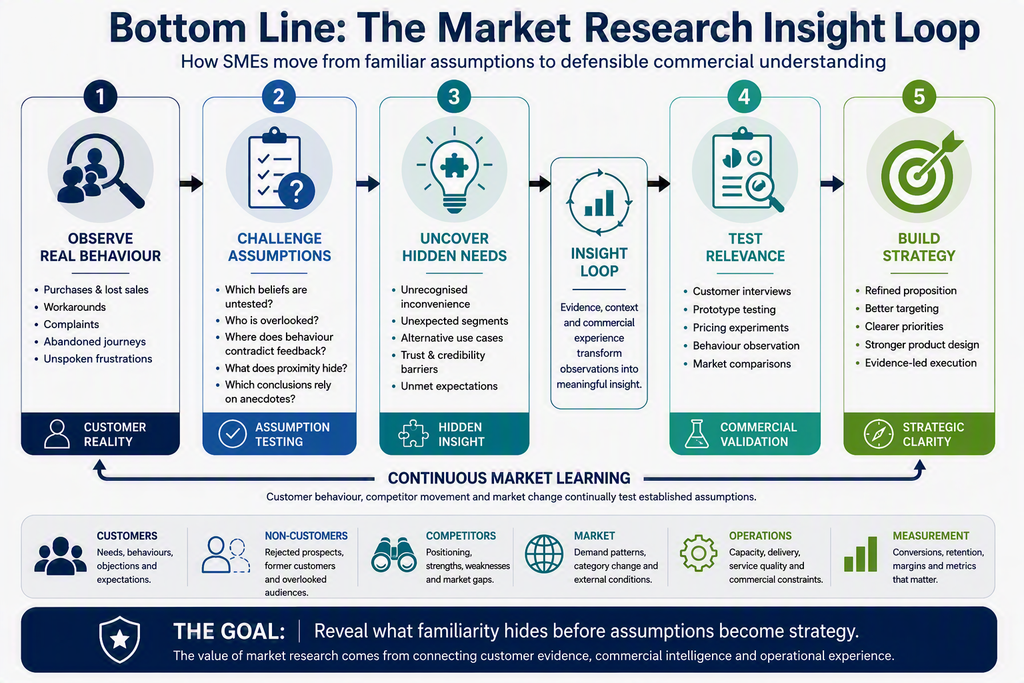
Market research becomes especially valuable when it uncovers something the business did not know to ask. Research into empathic design shows that customers can explain frustrations, but may struggle to imagine solutions beyond their experience.
The development of OXO Good Grips shows how observation can uncover needs that customers have normalised. Founder Sam Farber noticed his wife struggling with a traditional vegetable peeler. Arthritis made its narrow metal handle painful to grip. Rather than asking consumers to imagine a better tool, the team observed how people handled existing products.
This insight produced a wider, non-slip handle that improved comfort for people with arthritis and the broader market. Customers had not explicitly requested ergonomic kitchen tools because many had simply accepted discomfort as normal.
For SMEs, the lesson is clear. Customers do not always articulate the problems that influence their experience. In some cases, they have adapted to inconvenience so completely that they no longer question it. Careful observation can expose these hidden needs and reveal opportunities that standard surveys may overlook. Consequently, market research helps businesses identify what customers genuinely value and build stronger commercial propositions around that understanding.
The Bottom Line: Confidence Over Guesswork
The value of market research will always face an attribution problem. Businesses bear its cost before experiencing its full benefits. One experienced marketing consultant described this experience candidly: research can act as a “treasure map” that uncovers hidden opportunities. However, clients often focus on the destination rather than the journey required to reach it.
Its strongest contribution often arrives quietly. Research may expose a risky assumption, identify an unexpected customer segment, or strengthen a commercial proposition. These outcomes rarely generate immediate headlines. Nevertheless, they improve the quality of every decision that follows.
Therefore, ambitious leaders should demand research that moves beyond commoditised templates and predictable conclusions. Genuine commercial intelligence tests assumptions, examines behaviour, and reveals what internal experience may overlook. Ultimately, market research reduces guesswork and builds grounded confidence, anchoring operational plans in defensible commercial reality.
***
At Northstar Consulting, we specialise in the rigorous market research and commercial intelligence that ambitious SMEs need to scale. We help founders eliminate strategic blind spots by uncovering the hidden behaviours and market realities that drive true growth. Through our market intelligence and friction audit, we ensure every operational decision is anchored in undeniable market evidence.