
Distributed talent nodes are changing how ambitious businesses use foreign subsidiaries as strategic capability hubs. Instead of transferring routine tasks overseas, companies are distributing ownership of engineering, digital products, data and other critical capabilities.
Historically, many executives approached international hiring through labour arbitrage. The objective was straightforward: move defined activities into lower-cost markets. However, apparent savings often conceal invisible costs involving coordination, rework, knowledge loss and weaker strategic alignment.
Distributed talent nodes follow a more valuable logic. They place specialist capabilities within the enterprise and give international teams responsibility for outcomes, rather than isolated tasks.
Do not distribute tasks. Distribute capability.
Distributed Talent Nodes Move Beyond Cost Arbitrage
Traditional outsourcing purchases predefined outputs from an external provider. The supplier manages delivery and talent, while the client controls requirements. Cost, capacity and service efficiency usually drive the relationship.
By contrast, distributed talent nodes develop proprietary knowledge and assume responsibility for meaningful business outcomes. A node might manage a global platform, lead product engineering or operate an enterprise-wide analytics capability.
India provides the clearest evidence of this transition. In 2024, its global capability centre ecosystem included more than 1,700 organisations and 2,975 centres. Together, these centres employed over 1.9 million people and generated approximately US$64.6 billion. Of these centres, almost 90% supported several functions, while more than half have evolved into strategic hubs that managed portfolios of capabilities or led wider enterprise transformation programmes.
These figures reveal an important distinction. A genuine strategic capability hub retains knowledge, develops leaders and influences enterprise decisions. If headquarters controls every significant decision, the subsidiary remains an execution centre.
Why Distributed Talent Nodes Matter Now
Many domestic labour markets cannot supply digital and engineering skills at the required depth or pace. Demand now extends beyond software developers towards AI specialists, cloud architects, cybersecurity professionals and digital product leaders.
A review of more than six million job advertisements across six Asia-Pacific economies found widespread demand for digital capabilities. Approximately 45% required basic digital literacy, while almost 30% required intermediate skills. More than 10% sought advanced capabilities. Between 2019 and 2024, the commercial demand for AI-related capabilities accelerated significantly, establishing advanced digital skills as a critical requirement for global enterprises.
Digital services are increasingly tradable across borders, although distribution and access remain uneven and disproportionately favour skilled environments. Consequently, securing advanced capabilities, developing competitive markets, and accelerating strategic investment are now essential for sustainable growth.
Therefore, distributed talent nodes must be built around capability access rather than low wages. While cost remains relevant, it cannot sustain the operational model when specialist salaries rise or competing employers enter the market.
Distributed Talent Nodes Create An SME Opportunity
Strategic capability hubs are no longer reserved for major multinationals. Scaling SMEs can build smaller, specialised nodes around one high-value mandate, such as product engineering, cybersecurity or data analytics.
These compact structures are sometimes described as micro or nano capability centres. Their value comes from focus, rather than headcount. A 20-person subsidiary with genuine product ownership may create more value than a 200-person delivery centre restricted to predefined activities.
For SMEs, distributed talent nodes provide a practical route towards borderless growth. Smaller businesses do not need to recreate the vast centres operated by multinational companies. Instead, they can target capabilities that directly constrain growth.
However, leaders must first determine whether the talent requirement is enduring and strategically important. For bounded, non-core assignments, independent contractors remain highly suitable. To rapidly test a new global market without the financial burden of incorporating a local legal entity, organisations can utilise an Employer of Record (EOR), a third-party partner that legally employs, pays, and manages local compliance for staff on your behalf. Conversely, establishing a captive subsidiary becomes essential when the mandate requires strict knowledge retention, proprietary intellectual property creation, and dedicated local leadership.
Crucially, an Employer of Record remains a transactional hiring mechanism rather than a complete internationalisation solution. While it accelerates initial market entry, it does not eliminate complex corporate risks involving cross-border taxation, data protection, intellectual property ownership, or absolute workforce control.
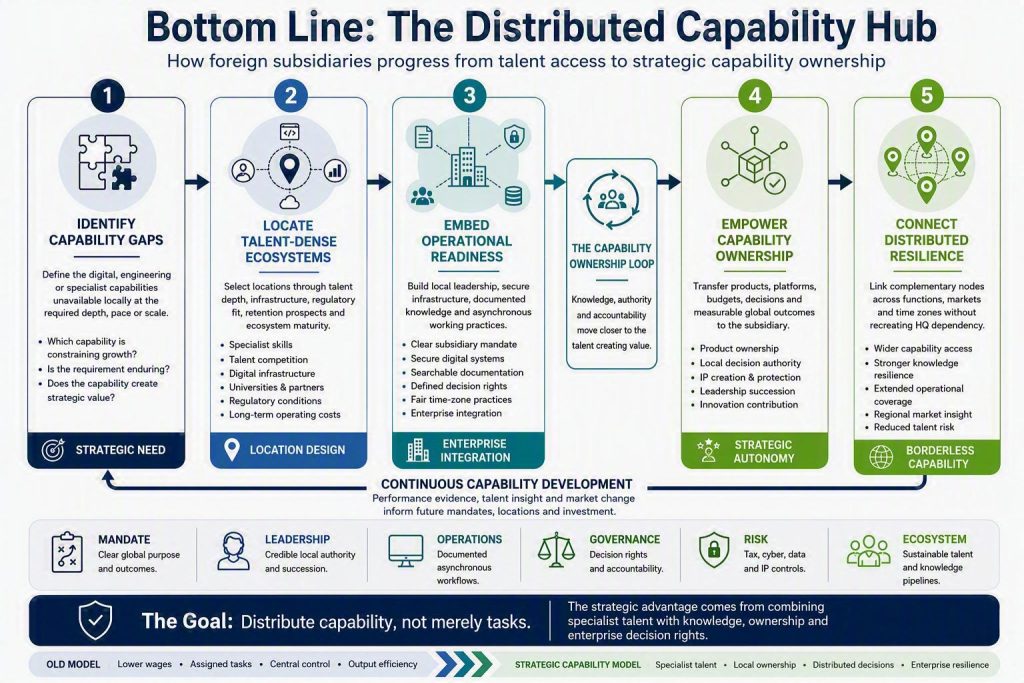
Engineering Operational Readiness and Asynchronous Design
The most common misstep in global expansion is recruiting an international team before engineering a robust operating model. Every distributed talent node requires a precise mandate. Rather than assigning basic activities like coding or processing, leaders must establish genuine commercial ownership.
Furthermore, decision rights must expand as the subsidiary proves its capability; these hubs cannot generate enterprise value if headquarters bottlenecks every technical and financial decision. Ultimately, a foreign subsidiary cannot repair a weak internal operating model, as it will only expose it.
This operational vulnerability is severely amplified by time-zone differences. While global distribution extends service coverage, it does not automatically yield productivity. Extensive research confirms that without clear systems, time-zone gaps create dangerous execution failures and push work into unsociable hours.
Therefore, effective distributed nodes require a deliberately asynchronous architecture. Decisions must be rigorously documented, responsibilities made entirely visible, and agreed response times must permanently replace the expectation of constant availability.
The governing operational principle is straightforward: document by default, meet with purpose, and escalate according to risk.
To sustain this framework, businesses must conduct regular friction audits between headquarters and each capability hub. By monitoring decision turnaround times, repeated handovers, and leadership bottlenecks, organisations ensure their distributed model maintains true commercial readiness.
Architecting Capability: Location Strategy and Local Leadership
Deploying a strategic capability hub requires treating global talent markets as highly nuanced ecosystems. Location strategy must strictly follow capability. Major offshore destinations are rarely homogeneous, as different cities within the same jurisdiction often develop entirely distinct specialisations. One urban centre may dominate product engineering, while a neighbouring region drives rapid industrial innovation or complex financial services. Consequently, the most resilient strategic architecture frequently deploys complementary distributed nodes across multiple jurisdictions.
However, emerging markets present structural constraints demanding rigorous commercial intelligence. Recent data highlights that 60% of employers in rapidly developing regions expect local skills gaps to impede business transformation. Furthermore, broader industry analysis indicates that intense regional competition and wage inflation have rapidly eroded the traditional cost advantages of legacy outsourcing.
To navigate these complexities, geographic strategy must directly mirror the distinct skill clusters native to each regional hub. Aligning specific technical competencies, whether specialised systems architecture, advanced data engineering, or cloud infrastructure, with regional capability strengths ensures distributed nodes operate as true centres of excellence rather than mere administrative extensions.
Mature distributed nodes empower local technical leaders who possess deep domain expertise and direct autonomy over engineering standards and skill development. By embedding this specialised capability and cultivating continuous research and academic partnerships, ambitious enterprises actively nurture regional technical talent rather than simply extracting existing market resources.
The Leadership Imperative For Distributed Talent Nodes
Financial governance must evolve alongside the operating model. While transactional savings and raw delivery capacity frequently justify the initial business case, they remain entirely inadequate for measuring long-term strategic value.
Instead, modern commercial intelligence requires tracking product ownership, release quality, innovation output, and leadership succession. Furthermore, executive boards must measure how these distributed nodes actively enhance customer outcomes and operational resilience during market disruption.
Ultimately, deploying a distributed talent node is a fundamental organisational design decision, not a tactical international hiring exercise. These hubs only succeed when specialist talent is granted the absolute autonomy, proprietary knowledge, and technical infrastructure required to generate genuine enterprise value.
The ultimate test of a strategic capability hub is its hypothetical absence. A foreign subsidiary has truly matured when its loss would mean forfeiting far more than mere labour capacity. The enterprise would actively lose critical innovation, market insight, and its fundamental ability to compete.
The most resilient modern enterprises do not distribute tasks to chase lower costs. They engineer distributed talent nodes to secure lasting commercial capability and borderless competitive advantage.
***
At Northstar Consulting, we partner directly with ambitious founders to achieve sustainable borderless growth. We help leaders eliminate the invisible costs of international expansion while building vital commercial intelligence rapidly. By rigorously stress-testing your operational readiness, we ensure your distributed talent nodes anchor directly to a defensible business strategy.