Export is not really in the plan for many UK players in Q2 2026. In fact, the latest data confirm that in Q2 2026, just 16% of exporters reported increased export orders, down from 25% in Q1, with 26% reporting a fall.
In the past twenty years, export orders have only been worse during the pandemic and the 2008/9 financial crash.
The more instructive figure is the split by firm size. Among micro-exporters with fewer than ten employees, only 11% reported increased export orders.
Among exporters with more than 250 staff, 26% did. The same tariffs, the same disrupted shipping lanes, the same currency movements — and more than double the success rate at the larger end.
That gap is in operational infrastructure and margin buffer. Larger exporters absorb friction that smaller ones cannot, because they have already built the systems that price it in. Our recent research set out to make this problem visible: the Friction Audit
What the framework does
Most internationalisation theory — staged entry, network-led entry, born-global models — answers the question “where should we go, and how?”. Macro risk analysis covers political stability, currency exposure and regulatory direction. Very little addresses what happens next: whether the transaction cycle a firm has designed will survive contact with real customs enforcement, real payment rails and real consumer expectations.
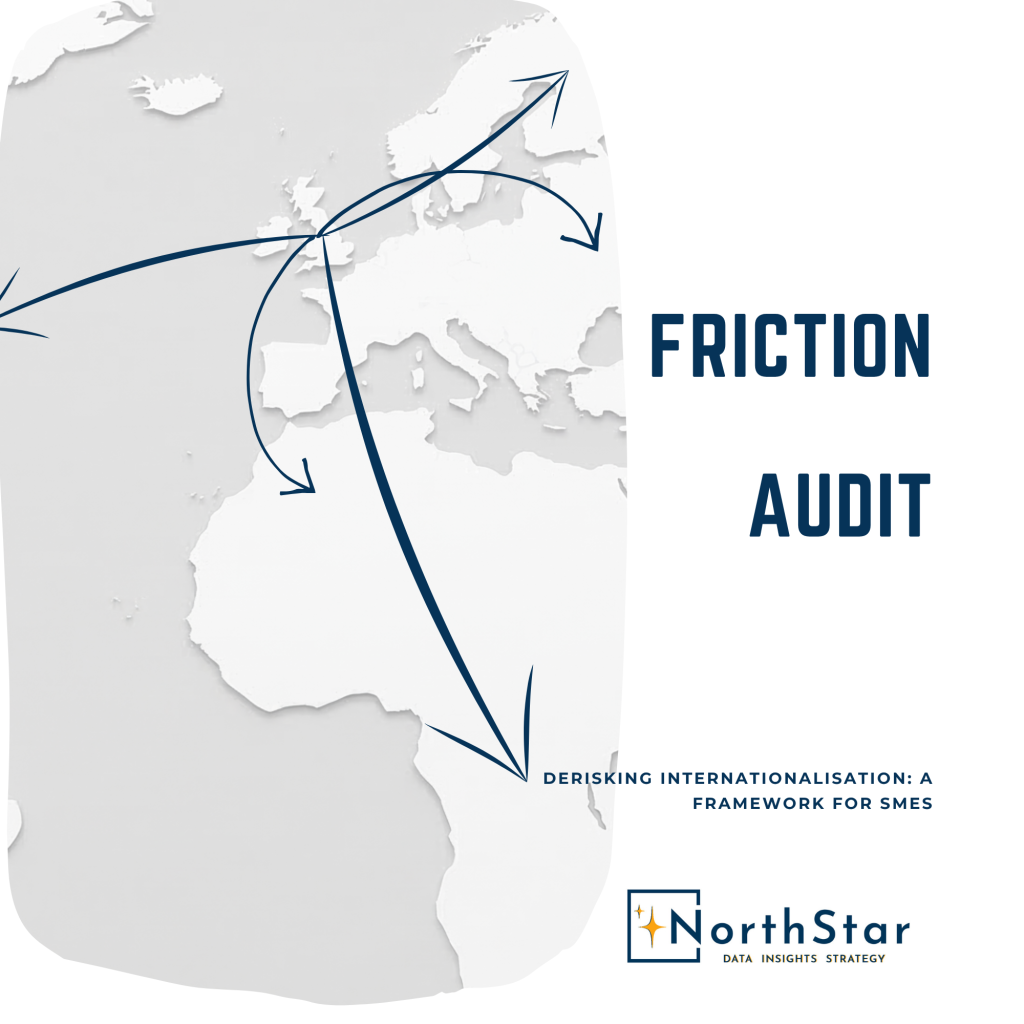
The Friction Audit Framework reorients the question from where should we go? to where are we least exposed? It emerged from a fourteen-month applied study of six UK-based SMEs in food and beverage and education, pursuing entry into South Korea, Hong Kong and Vietnam, drawing on financial and logistics audits across 47 shipment cycles and live scenario modelling during genuine market-entry decisions.
It is pattern recognition across repeated operational failures, not a statistically generalisable model — but the patterns were consistent.
Three findings
Unit-cost myopia. When businesses set prices for international sales, they often focus only on the basic cost of their products, ignoring the bigger picture of what it truly costs to export.
For example, a product might cost £2.20 to produce, making it seem like a good deal compared to a $10 retail price in South Korea. However, once you add expenses like shipping, customs fees, and the profit margin that distributors need, the actual cost could rise to about £4.75. This leaves only £3.05 for marketing, handling returns, and other costs. These hidden costs can squeeze profit margins and make exporting less viable. Companies need to consider the full landed cost when they think about internationalisation and exporting. By doing so, they can better understand their pricing strategies and manage risks effectively.
Fulfilment as reputational risk. Delivered Duty Unpaid shipping looks efficient from the exporter’s side, but it relocates an unpredictable cost to the doorstep, where a courier asks the customer for money they were not expecting. Eroded trust, and returns that on long-haul routes are cheaper to destroy than recover, are a direct and avoidable contribution to the liability of foreignness.
Reversibility beats commitment. The firms that sustained growth preserved optionality — smaller shipments, direct-to-consumer routes, 3PL arrangements, pop-up formats — structures built for rapid scaling or graceful retraction, rather than fixed local infrastructure that removes the ability to retreat.
What follows for export practice
Treat internationalisation and export as a transaction architecture problem, not a geography problem. The firms in our study that succeeded did not ask which market was largest; they asked which market would let them run a full transaction cycle without structural friction. South Korea worked for several of them not because of market size but because Delivered Duty Paid was enforceable and payment rails were standardised — a point with added weight now that improved market access under the UK–South Korea agreement is one of the few bright spots in an otherwise difficult trade picture.
Front-load the detection of unit-level cost volatility. Any firm that cannot produce a fully loaded landed cost per unit is not ready to commit inventory.
And design for reversibility. Optionality carries a cost. With UK exports forecast to fall this year and Middle East disruption still working through global supply chains, it is worth paying.
None of this replaces macro risk analysis or legal due diligence. The contribution is narrower: making visible the operational friction that existing frameworks miss. In Scotland, where around a fifth of trading businesses currently export, the constraint on that number is rarely appetite. It is whether the economics survive the journey.
Internationalisation remains one of the strongest growth routes open to a Scottish SME. It is also, right now, a margin defence discipline. Scale what does not leak.