
How SMEs Can Package Value and Build Sustainable Profit
The pricing trap becomes visible when a full diary produces impressive revenue but leaves too little retained profit. Many service-based SMEs and independent operators appear successful from the outside. Their teams remain busy, client demand looks healthy, and invoices continue rising. However, the owner still works excessively, investment feels difficult, and profit remains disappointing.
Current figures illustrate this tension. A 2025 survey found that 74% of UK small businesses planned to increase prices, yet only 17% expected their profits to rise. Another review of 140,000 UK businesses found that while profits still increased by 3.7%, real revenue declined by 0.2%. These results show why higher prices alone cannot guarantee stronger profitability.
The pricing trap is not simply about charging too little. It develops when pricing becomes disconnected from customer value, delivery reality, and sustainable profit. Escaping it requires more than confidence. SMEs need commercial intelligence, clearer service packages, and much better visibility over what each engagement actually contributes.
The Pricing Trap Behind the Full Diary
Hourly billing offers genuine advantages. Clients understand it, providers can measure it, and both sides retain flexibility when requirements change. Therefore, hourly pricing remains suitable for exploratory work or projects with uncertain scope.
Nevertheless, the model creates an artificial growth ceiling when used without question. Revenue remains tied to available capacity. Once the founder’s calendar is full, growth requires higher rates, longer hours, or additional employees.
The Pricing Trap becomes particularly visible when efficiency improves. An experienced adviser may solve a client’s problem in ten hours rather than twenty. The client receives the same result, but the provider invoices less. Consequently, accumulated expertise and improved execution reduce revenue instead of increasing margin.
Time is also becoming a weaker measure of value as artificial intelligence accelerates professional work. Generative AI use across professional services organisations increased from 22% to 40% within one year, yet only 18% reported measuring the resulting returns. As routine work becomes faster, providers must explain why clients are paying for judgement, interpretation, and reliable outcomes rather than hours alone.
The hourly rate therefore becomes restrictive when specialist value extends beyond delivery time. However, abandoning hourly billing without improving the underlying offer simply creates another pricing trap.
How SMEs Build Their Own Pricing Trap
Most SMEs inherit their pricing rather than design it. Rates established during the company’s early years often survive after its expertise, recognition, and costs have changed.
Competitor comparison reinforces this pattern. Owners may copy prevailing rates without understanding their competitors’ staffing, margins, technology, or service boundaries. The resulting price looks commercially reasonable, but may not support the economics of their own business.
The pricing trap also develops through small concessions. One extra meeting appears harmless. A further revision protects the relationship. Informal support demonstrates goodwill. Yet these additions accumulate until the business delivers substantially more than the client purchased.
These are the invisible costs of service delivery. They can include unpaid discovery, excessive administration, custom reporting, rushed deadlines, and senior expertise applied to routine work. The project may reach its revenue target while creating much less profit than expected.
As an example, an additional 50 hours spent on a fixed-fee contract resulted in a £2,250 reduction in gross profit. The extra work also lowered the projected gross margin by more than 11 percentage points. The figures are illustrative, but the principle is important. Revenue may remain unchanged while profitability deteriorates quietly.
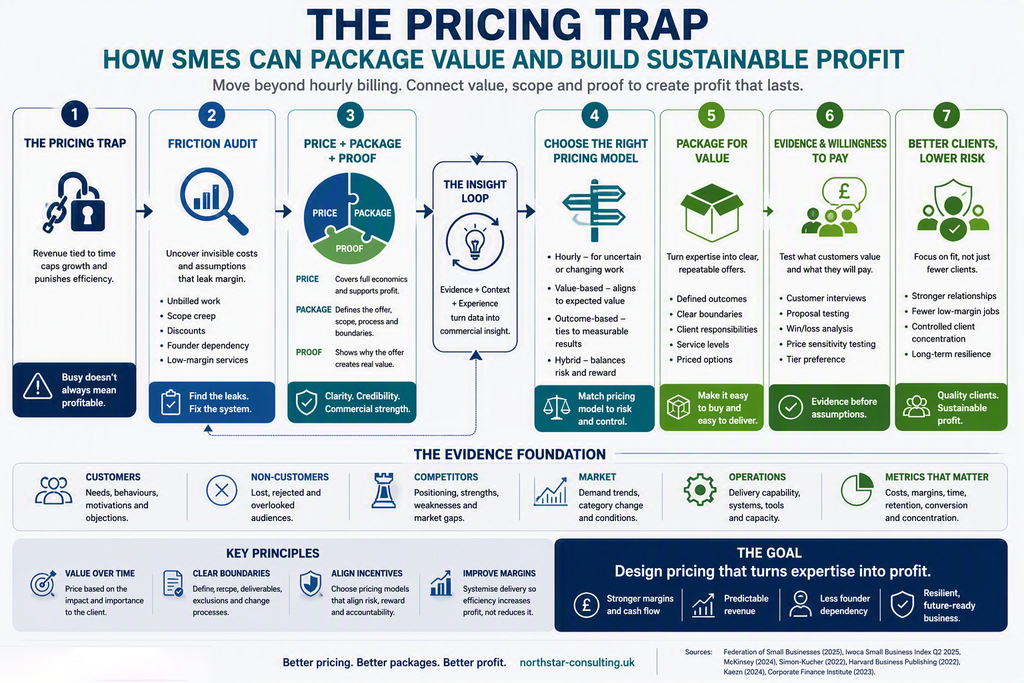
A commercial friction audit can expose these weaknesses. It should compare quoted scope with actual delivery, identify repeated exceptions, and examine which services remain dependent upon the founder. It should also reveal which engagements generate revenue without supporting meaningful retained profit.
Price + Package + Proof = Sustainable Profit
Escaping the pricing trap requires more than increasing prices or replacing hourly rates with fixed fees. A stronger commercial model must connect three elements: viable pricing, a clearly structured package and credible proof of customer value. If one element is missing, the model remains unstable. A strong price cannot rescue an unclear package. Equally, an attractive package cannot justify its price without credible proof.
The price must support the full economics of delivery. It should cover labour, overheads, owner remuneration, tax obligations, profit and reinvestment. However, internal costs alone cannot determine the final price. The fee must also reflect the customer’s perceived value, available alternatives and the commercial importance of the problem being solved.
The package must organise expertise around a defined client problem. It should explain the process, timeframe, responsibilities, support level and intended outcome. Clear exclusions are equally important because every undefined boundary creates potential scope leakage. A well-designed package makes the service easier to understand, deliver and purchase.
Finally, proof must demonstrate why the proposition creates value. This may include case studies, specialist experience, customer evidence, a distinctive method or measurable improvements. Providers cannot declare value unilaterally because customers ultimately decide whether an offer deserves its price. Therefore, strong pricing requires credible evidence of the commercial benefit.
Research into service productisation reinforces this approach. Productisation transforms variable services into defined propositions through standardisation, modular delivery, distinctive positioning and transparent pricing. Consequently, intangible expertise becomes easier for customers to understand, compare and purchase.
However, effective packaging does not mean placing more deliverables beneath one attractive fee. That approach increases delivery complexity and deepens the pricing trap. Instead, SMEs should standardise the delivery core, establish clear boundaries and price genuine variation separately. Price, package and proof must work together to protect customer value and sustainable profit.
Better Clients, Stronger Evidence, and Controlled Risk
Stronger packages can help SMEs earn more from fewer, better-matched clients. They reduce repeated selling, onboarding, administration, and disruptive context switching. However, fewer clients do not automatically create resilience. Excessive dependence on one account can weaken negotiating power and expose the business to sudden revenue loss.
A customer contributing around 20% of revenue is often treated as a warning, although appropriate thresholds vary by sector and contract structure. The objective is therefore not simply fewer clients or higher prices. It has fewer low-margin engagements, stronger relationships, and controlled client concentration. Otherwise, the pricing trap can reappear through dependency. Corporate Finance Institute
Avoiding that outcome requires customer evidence. Pricing confidence should follow research rather than replace it. SMEs need to understand what different customer groups value and how willingness to pay varies between them.
Customer interviews, proposal comparisons, win-loss reviews, and price sensitivity testing can reveal acceptable ranges and purchasing trade-offs. However, businesses should not rely solely on asking customers what they would pay. Hypothetical answers may differ from actual purchasing behaviour. Instead, SMEs should present genuinely differentiated packages and examine how buyers respond.
Ultimately, the metrics that matter extend beyond quoted revenue. SMEs should track conversion, delivery costs, discounts, revisions, retention, client concentration, and realised margin. Together, these measures reveal whether stronger packages attract suitable clients or simply create another Pricing Trap.
Sustainable Profit Is Designed
The Pricing Trap is not escaped by charging more for unchanged work. Nor is it solved by replacing hourly rates with fixed fees. SMEs must redesign the relationship between customer value, service scope, delivery reality, and retained profit. Otherwise, a new pricing model may simply conceal the weaknesses of the old one.
Hourly billing can remain useful when requirements are uncertain or likely to change. Value based packages work when the customer’s problem, expected value, and service boundaries are understood. Outcome based agreements demand more. They require reliable measurement, sufficient provider control, and shared accountability for the final result.
However, pricing decisions cannot be separated from the wider commercial model. Stronger packages need credible proof, disciplined delivery, and evidence of willingness to pay. They must also attract suitable clients without creating excessive dependence on a few accounts. Therefore, quoted revenue is only the starting point. The metrics that matter include realised margin, delivery costs, scope expansion, retention, and client concentration.
Ultimately, the Pricing Trap describes any commercial model that obscures invisible costs, commoditises expertise, or rewards activity without creating sustainable profit. Escaping it requires commercial intelligence, controlled packaging, and a strategic architecture built around value and delivery. Sustainable profit is not discovered at the end of a busy year. It is designed into every price, package, boundary, and client relationship from the outset.
***
At Northstar Consulting we help businesses test willingness to pay and understand what different customers genuinely value. Our pricing strategy insights provide further guidance on packaging, positioning, and protecting margins. SMEs seeking tailored support can also explore our commercial advisory and pricing options.
Through our market research services, we help businesses test willingness to pay and understand what different customers genuinely value. Our pricing strategy insights provide further guidance on packaging, positioning, and protecting margins. SMEs seeking tailored support can also explore our commercial advisory and pricing options.
The Pricing Trap rarely begins with one visibly incorrect price. It develops through uncontrolled scope, poorly structured offers, and services that consume more value than they retain.