…and we’re asking academics to share their point of view
In a recent post focused on preparing for commercialisation and due diligence in 2027, we flagged something buried in UKRI’s data that we monitor with interest. Yet, few people seemed to be talking about.
In recent months, however, the interest in and emphasis on innovation and commercialisation beyond STEM have garnered significant attention in the EU, just as they have in the UK.
We laid out the honest arithmetic behind Europe’s new commercialisation infrastructure — real money, but priorities repeatedly funded at a scale smaller than the problem they name. Read together, both pieces made the same argument from different angles: the support exists, but it rewards those who look, and it was built almost entirely around one model of what “commercialisation” means.
Today, that argument gets a concrete update.
What UKRI already recognises
As indicated by recent data, approximately 60% of spin-outs originating from arts, humanities and social sciences backgrounds have unknown sectoral data. Not a rounding error. Not a niche category. The majority of activity in this space, and the infrastructure built to track UK commercialisation, simply doesn’t see it.
We believe that this was a measurement failure, not a market failure. Gravity Sketch — a Royal College of Art spin-out now working with Ford, Adidas and Reebok, having raised a $33 million Series A — is UKRI’s own example of what arts-origin ventures can become when the infrastructure exists to support them. The problem was never potential, but it was the pathway.
What has changed: funding is now available
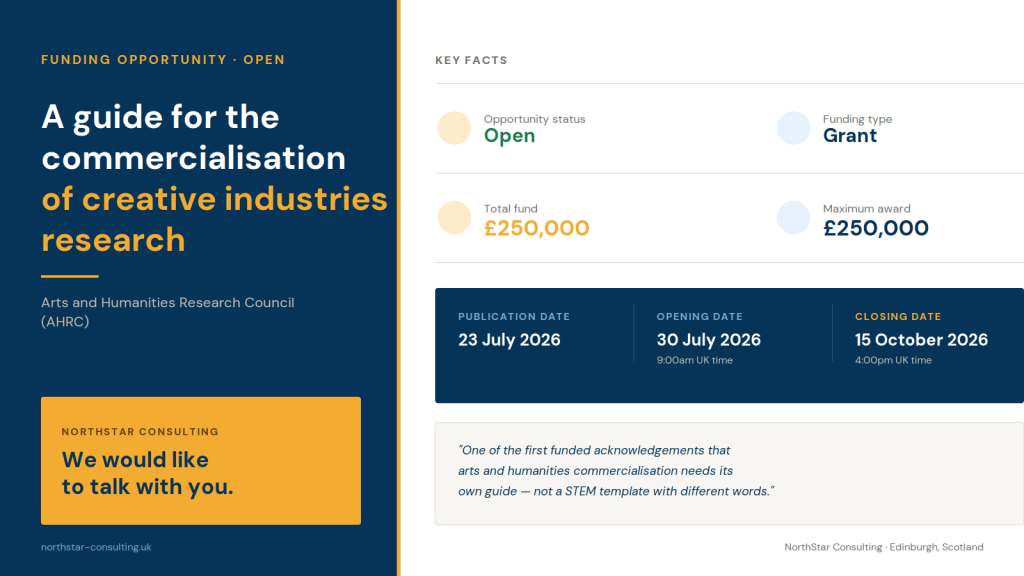
AHRC has opened a funding call that speaks directly to this gap: “A guide for the commercialisation of Creative Industries Research.” The details are quite precise and worth understanding: a total fund of £250,000, opening 30 July 2026 and closing 15 October 2026. It’s a university-led call, but the brief explicitly asks for teams built with investors, lawyers and founders: people who understand commercialisation in practice, not just in theory.
This is, as far as we can tell, one of the first funded acknowledgements that arts and humanities commercialisation needs its own playbook — not a STEM template with different words in it.
It’s a genuine start, although not an answer on its own (as of yet).
A guide that builds on understanding
Building a sector-specific commercialisation guide that actually works requires something no desk research can substitute for: talking to the people who have tried to take a piece of arts, humanities or social science research to market and hit walls that don’t exist in a STEM lab.
Walls like: what does IP ownership even mean for a creative or cultural methodology? What counts as “proof of concept” for a design practice, a heritage framework, or a piece of behavioural research? How does an investor who has only ever evaluated a patent pipeline learn to recognise a strong SHAPE-origin venture when they see one?
These aren’t rhetorical questions but the actual, specific points where — based on everything we’ve read across seven months of researching this space — the current commercialisation architecture breaks down for researchers outside STEM.
We are asking for input
We could write another analysis piece extrapolating from the data we already have. We have consistently done that and keep on doing it. However, what we don’t have — and what no amount of desk research will produce — is the lived experience of someone who has actually tried to do this.
So we’re asking directly: if you are an academic working on commercialisation in arts, humanities or social sciences — or you know someone who is — we would genuinely like to talk to you.
This isn’t a survey link or a data-collection exercise. It’s a conversation, and it will directly shape what we publish next, and potentially how we support academics navigating the AHRC call itself.
[Get in touch] · [Read our analysis] · [Read our reports]