Establishing a clear business strategy remains essential for ambitious enterprises pursuing sustainable borderless growth. Following strategic planning sessions, decision-makers regularly come away with comprehensive plans backed by extensive operational documentation. However, leadership teams frequently suffer from the misconception that they have formulated a robust business strategy.
Empirical evidence suggests that they have merely produced a tactical roadmap. Operational activity does not equal strategic choice, and ambition never equals competitive advantage. Furthermore, execution milestones do not provide guaranteed evidence of genuine market success.
Distinguishing between these two concepts separates market leaders from busy organisations going nowhere. Ultimately, an evidence-led strategy transforms organisational intent into lasting commercial success.
The Planning Illusion Hurting Your Business Strategy
Organisations naturally gravitate towards planning because it creates a comforting illusion of control. Detailed plans produce spreadsheets, deadlines, accountable owners and highly measurable targets. They map an uncertain future into apparently manageable and predictable linear steps.
Conversely, an effective business strategy forces businesses to confront uncomfortable market realities directly. Decision makers must manage macroeconomic uncertainty while making difficult choices regarding capital allocation. For example, an owner-operator might plan to increase top-line revenue by 15%. Alternatively, a solopreneur could plan to enter entirely new international markets. They could also deploy a new customer relationship management software platform. Furthermore, founders might modernise another operational part of the business entirely. These choices merely coordinate operational activity rather than establishing a defensible business strategy.
However, none of these operational goals explains why clients will choose the company. Indeed, a long list of priorities often indicates a weak business strategy. When organisations deem everything strategic, they ultimately prioritise absolutely nothing of value. As a result, businesses risk valuable capital on unvalidated operational assumptions.
The Strategic Architecture of Sustainable Advantage
Operational planning focuses primarily on the internal coordination of various organisational actions, while a business strategy centres completely on the logic of value creation. A robust business strategy must define a coherent set of difficult choices under market uncertainty. Crucially, this process requires moving beyond generic revenue logic towards a comprehensive value logic.
Industry data reveal that high-performing organisations build a defensible strategic architecture. This value logic defines how the organisation creates, delivers and captures value. A defensible business strategy explicitly answers critical questions regarding competitive positioning. Business leaders must determine which specific customer problems they understand best today. They must also decide what distinctive proposition they will offer to clients. Furthermore, they need to identify which proprietary capabilities make that proposition credible.
Businesses must specify which market opportunities they will actively adopt or reject. This final choice regarding exclusion frequently reveals the strength of a business strategy.
Execution and Intelligent Operations
Historically, businesses treated business strategies as a rigid multiple-year planning horizon. Conversely, typical operational planning focused on short-term execution spanning weeks and months. In contemporary accelerated markets, this time-based distinction remains entirely obsolete.
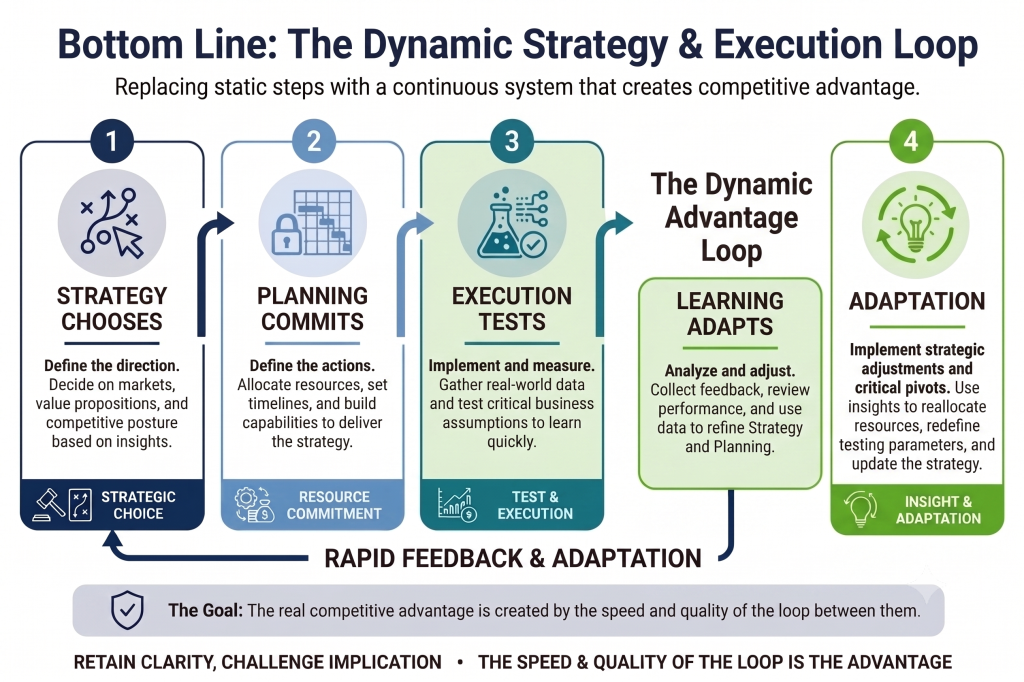
Strategy and planning must function together within a continuous corporate management loop. They are not competitors, but rather answer entirely different organisational questions. Businesses must successfully validate markets and securely scale their existing operations. Therefore, they must completely abandon traditional linear waterfall project planning approaches. Instead, organisations should adopt intelligent operations to bridge the dangerous execution gap.
The underlying metrics confirm that execution serves as an ultimate reality test for leadership.
- Diagnose the central market challenge facing ambitious SMEs and solopreneurs.
- Make strategic choices regarding where to concentrate effort effectively.
- Define the proprietary data and specialised skills required.
- Deploy capital strictly while deliberately defunding legacy activities.
- Assign clear accountability, strict deadlines and precise performance measures.
Finally, owner-operators must rigorously stress test their business strategy using the metrics that matter. Execution generates vital operational intelligence to evaluate these underlying market assumptions continuously.
A comprehensive friction audit quickly reveals where initial hypotheses require an immediate pivot. This evidence-led strategy guarantees true commercial readiness for ambitious solopreneurs today.
Adapting Business Strategy in the AI Era
The shifting metrics paint a picture of artificial intelligence commoditising operational planning. Advanced algorithms can quickly generate detailed implementation roadmaps, risk registers and schedules. However, this technological convenience creates a severe new risk for enterprise leadership, as executives face the temptation to produce highly polished operational plans quickly. This frequently leads to taking decisions and implementing solutions without developing a better underlying business strategy.
Competitors within a sector often use similar artificial intelligence models trained identically. They generate highly similar market analysis reports and capital resource allocations. The inevitable result of this technological behaviour is widespread strategic corporate convergence. Everyone attempts to execute the exact same playbook, eroding competitive differentiation entirely. In this landscape, technology makes operational planning cheaper, but demands human courage.
Possessing artificial intelligence will never guarantee an enduring and profitable market advantage. True advantage comes from combining technology with an evidence-led strategy. Furthermore, businesses must embrace rapid market experimentation and highly decisive leadership judgement.
The Leadership Imperative for Your Business Strategy
***
At Northstar Consulting, we partner directly with ambitious founders to achieve sustainable borderless growth. We help leaders eliminate invisible costs while building vital commercial intelligence rapidly. Through our specialised Frictionless Audit, we rigorously stress-test your supply chains and compliance routes to uncover hidden margin leaks before you scale. We ensure every operational plan anchors directly to a defensible business strategy.