Business model innovation across Asian markets is changing how companies validate demand, build trust, organise production, access distribution, and reach underserved customers. The most transferable lesson is not which technologies these businesses use, it is which commercial assumptions they are willing to redesign.
Western commentary often explains growth across Asian markets through large populations, manufacturing depth, and rapid digital adoption. These conditions matter, but they overlook a deeper shift. Businesses are also experimenting with emotion-led products, community commerce, demand-tuned production, shared digital infrastructure, and AI-native delivery. Recent research identifies six business models gaining traction across different Asian markets and industries.
UK and EU SMEs should focus on adapting the underlying growth mechanisms of these models locally, rather than attempting to reproduce them at scale. The core value lies in understanding and applying their economic mechanisms to smaller, agile frameworks. The challenge is to separate large-scale examples from the business model innovation that SMEs can adapt to their needs and context.
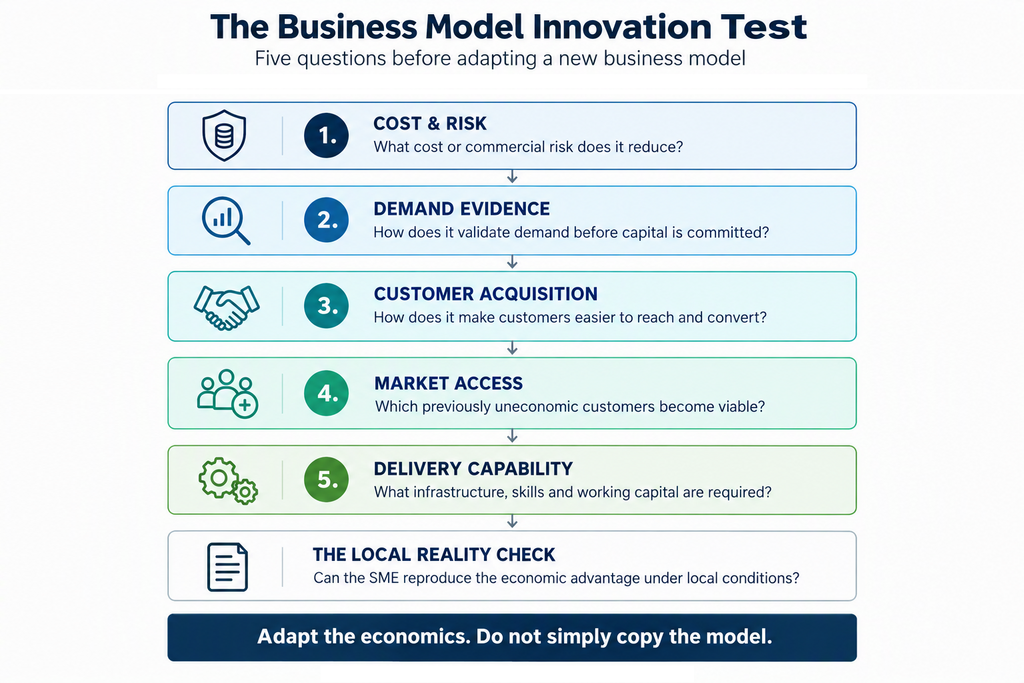
The Business Model Innovation Test
Before adapting an unfamiliar business model, SME leaders should examine whether it changes the underlying economics of the business. The starting point is cost and risk. A worthwhile model should reduce inventory exposure, acquisition costs, delivery expense, or another material commercial constraint.
Leaders should then assess the quality of demand evidence. Pre-orders, customer deposits, pilot programmes, and observed purchasing behaviour provide stronger validation than interest alone. The model should also make customers easier to reach, reassure, and convert without creating excessive dependence on paid platforms.
The next question concerns market access. Some models become transformative by making previously uneconomic customer groups commercially viable. However, reaching those customers still requires suitable infrastructure, skills, working capital, governance, and delivery capacity.
Finally, every imported model needs a local reality check. UK and EU SMEs must establish whether the economic advantage survives different customer behaviours, operating costs, regulations, and market structures. Business model innovation should adapt the underlying economics, rather than copy the visible model.
Business Model Innovation Starts by Validating Demand
Traditional operating models often require SMEs to forecast demand, commit working capital, and then invest in generating customer interest. Several Asian models reverse that sequence by producing commercial evidence before substantial capital is exposed. SHEIN, the global online fashion retailer, for example, initially produces 100 to 200 items and expands production only after measuring genuine customer demand
Pop Mart, the global designer toy retailer, demonstrates how collectability, anticipation, character ownership, and customer rituals can become part of a revenue model. The lesson is not to manufacture artificial scarcity. It is to build emotional engagement into the proposition rather than adding it through advertising afterwards.
UK and EU SMEs can apply this principle through paid pre-orders, micro-batches, closed customer communities, pilot collections, configurable products, and staged B2B service launches. All these create a closer link between customers and their experience, with the brands and companies that provide them.
As an example, a specialist manufacturer could invite selected customers to configure and reserve a limited pilot product. Deposits, chosen specifications and related customer insights would provide stronger demand evidence than a conventional survey alone. The manufacturer could then refine the proposition and scale production around the configurations attracting genuine purchasing intent.
These approaches do not remove inventory risk, particularly where supplier deposits, minimum order quantities, returns and cancellations remain significant. However, they enable businesses to test demand, limit dead-stock exposure and preserve working capital before committing to larger production volumes. Business model innovation begins when demand evidence arrives before full supply commitment.
From Paid Attention to Earned Authority
Many UK and EU SMEs repeatedly rent access to audiences through platforms they do not control. Advertising may create immediate visibility, but the platform retains substantial influence over costs, reach, customer data, and future access.
For example, India’s Zerodha and Groww illustrate how Asian financial platforms have redesigned retail investing. Zerodha combined discount brokerage with transparent pricing and proprietary digital tools. Groww made mutual funds, shares and other investments easier for new and self-directed investors. Both platforms supported participation through accessible educational content. By integrating education into the customer journey, they reduced uncertainty, strengthened investor confidence and lowered barriers to market participation.
Creator-led commerce extends this mechanism. Discovery, demonstration, social proof, and purchasing can occur within one connected journey. Trust does not sit outside the transaction, it becomes part of the customer journey.
UK and EU SMEs can translate this model through specialist research, diagnostic tools, calculators, practical guides, product demonstrations, and professional communities. These assets should solve recognised customer problems before requesting a sale.
However, success does not depend upon producing more content or pursuing engagement without direction. Both must build credible authority that reduces customer uncertainty and lowers future acquisition costs.
From Proprietary Systems to Shared Commercial Rails
Smaller companies often purchase ecommerce, payments, logistics, customer acquisition, and marketplace access separately. Closed platforms can simplify participation, but they also influence fees, customer visibility, commercial data, and trading conditions.
India’s Open Network for Digital Commerce provides an alternative model. Open protocols allow buyer applications, seller applications, and logistics providers to participate across a decentralised network. The initiative aims to widen digital market access, improve interoperability, and reduce dependence on closed marketplaces, particularly for smaller businesses.
Though The network cannot be transferred directly into European markets, its underlying principle remains relevant. SMEs do not always need to build, purchase, or control every commercial capability independently.
In the UK, Open Banking demonstrates how common standards can enable innovation across competing financial providers. This shared banking infrastructure now supports millions of active users and rapidly growing payment volumes.
Further integration could support similar models across Europe. Potential applications include account-to-account payments, sector marketplaces, shared logistics networks, purchasing consortia, interoperable product information and collaborative export infrastructure.
These models still require governance, cybersecurity, adoption, fraud controls, and reliable customer experiences. Shared infrastructure does not remove commercial responsibility. Instead, it changes where the business invests and which capabilities it accesses through partnerships.
Translate the Mechanism, Not the Surface Model
Asian markets do not offer one universal growth formula. Their business models emerged from different customer behaviours, infrastructure, regulations, income levels, and operating conditions. UK and EU SMEs must therefore translate the economic mechanism rather than copy its visible features.
That translation begins with customer relevance and unit economics. The model must address observed local behaviour and reduce a meaningful cost, risk, or capital constraint. Otherwise, the SME may adopt an impressive technology without improving the underlying business.
The organisation must also be ready to deliver. Skills, systems, working capital, partnerships, and management capacity all matter. Regulatory fit is equally important, particularly across GDPR, consumer protection, the EU AI Act, and sector-specific requirements.
Strategic control provides the final test. Growth should not come at the cost of customer ownership, commercial evidence, or intellectual property. Successful business model innovation adapts the advantage, protects control, and fits local commercial reality.
Business Model Innovation Begins with Challenging Assumptions
Asian markets offer a diverse portfolio of commercial experiments. These examples suggest that familiar SME constraints may reflect inherited design choices rather than fixed economic rules. For example, trust does not always need to be purchased through advertising. Distribution does not always require proprietary infrastructure, while AI can support customer value and revenue growth beyond back-office efficiency. Shared platforms, partner ecosystems and embedded intelligence can become central components of the commercial model.
UK and EU SMEs should not copy the visible features of large Asian businesses. They should isolate the economic mechanism, test it against local customer behaviour, and rebuild it around European regulation and commercial reality.
The strongest business model innovation removes a structural source of friction. It may reduce inventory exposure, deepen customer trust, widen market access or make underserved customer segments commercially viable. Commercial intelligence begins by investigating the assumptions and constraints that an industry has stopped questioning.
***
At Northstar Consulting, we help ambitious SMEs identify which customer behaviours, operating assumptions, and market structures are limiting growth. Our commercial intelligence connects market evidence with innovation strategy, intelligent operations, and commercially viable execution.
Through our market research services, we help businesses validate demand, understand customer behaviour, test emerging propositions, and identify overlooked market opportunities. Our reports and strategic insights examine changing markets, innovation patterns, and emerging routes towards sustainable SME growth.
Northstar Consulting helps SMEs translate international innovation into locally relevant, evidence-led business model innovation.