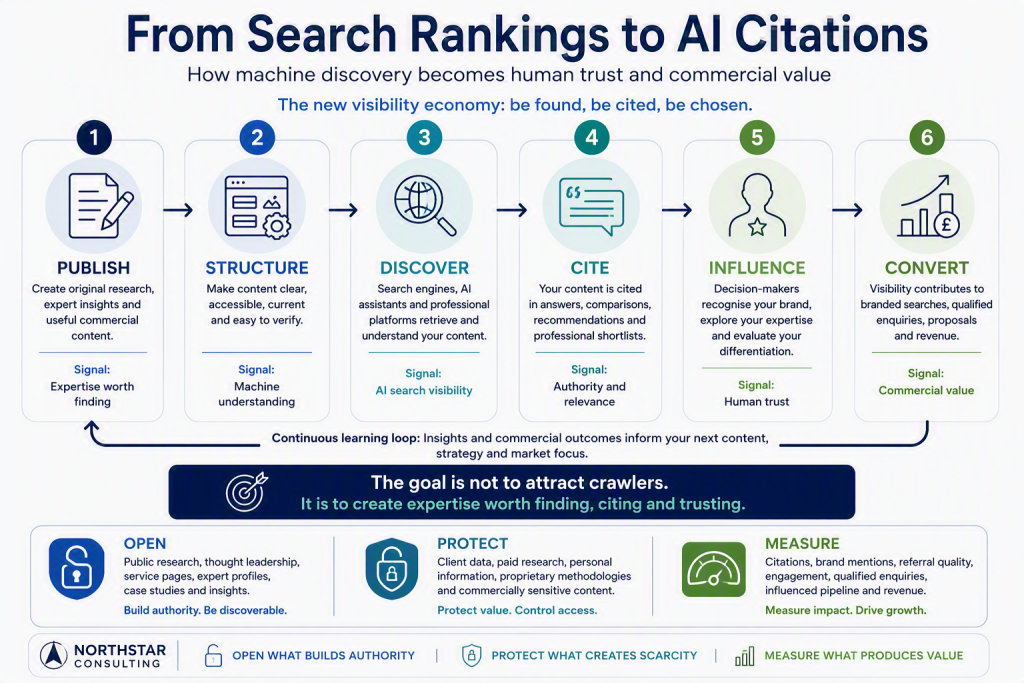
AI search visibility is reshaping how businesses earn attention, authority and commercial trust. Search rankings still matter, but they no longer define the entire discovery journey. Customers increasingly use artificial intelligence to research problems, compare providers and evaluate solutions before visiting any website.
Consequently, businesses face a more nuanced question. Is it always harmful when AI systems read public website content, or can machine discovery create valuable visibility?
For knowledge-led companies, AI discovery can amplify research, strengthen reputation and introduce expertise to new audiences. However, unrestricted extraction may reduce website traffic, weaken content control and expose proprietary material.
The strategic objective should not be universal access or complete exclusion. Instead, businesses need controlled discoverability.
AI Search Visibility Is Becoming Part Of Search And Promotion
AI increasingly shapes how customers discover, interpret and evaluate companies. However, AI search visibility now reaches far beyond the conventional search results page.
Google and Microsoft integrate generated answers into established search environments. ChatGPT, Claude and Perplexity support conversational research using current web information and cited sources. Meanwhile, Meta combines internet content with public discussions, creator material and community recommendations. LinkedIn adds a professional layer based on company pages, profiles, articles, skills, jobs and network relationships.
A customer may encounter a company through an AI summary, investigate its website, review its LinkedIn presence and consult social commentary before making contact. Therefore, visibility no longer depends on one position within one search engine as platforms are creating a connected discovery ecosystem.
Traditional SEO remains the foundation. Google confirms that technical accessibility, original content, clear structure, and a strong page experience support inclusion within its AI tools. This means that its AI systems conduct multiple related searches before selecting pages, allowing specialist websites to surface during complex research without holding top conventional rankings.
Microsoft follows a similar approach. Bing’s indexing infrastructure supports both conventional and AI results, meaning that content accuracy, freshness, crawlability, and authority dictate visibility across search and conversational discovery. To evaluate performance in AI answers, Microsoft provides reporting on cited pages, grounding queries, and citation trends effectively connecting traditional SEO practices with AI eligibility.
Conversational platforms extend this discovery journey further. A prospective client can ask ChatGPT, Claude, or Perplexity to compare advisers, explain strategic alternatives or identify relevant expertise. This means that they can retrieve current information and cite supporting sources. As a result, a company’s public profile, information and research can enter the decision process before the prospective client visits its website.
Social media platforms like those operated by Meta, or professional networking sites like LinkedIn, add yet another dimension. Posts, articles, short-form videos, community discussions, customer commentary and expert profiles provide signals about a company’s capabilities, reputation and relevance. Consequently, businesses need consistent terminology, current information and substantive thought leadership across their digital presence.
Implications for Businesses, Small and Large
A company’s AI search visibility depends on more than its website. Media coverage, industry databases, professional profiles and credible external references influence how AI systems interpret and represent the organisation. Citation-led platforms retrieve material from both the open web and specialist sources. Businesses, both small and large, therefore need a credible presence across the wider digital ecosystem.
These developments blur the boundary between search and promotion. AI systems now compare company content with external evidence before presenting selected organisations within summaries, recommendations and professional shortlists. A decision-maker may encounter a company’s research through AI, then return through search, social media or direct navigation. Conventional analytics may miss AI’s influence on that journey.
Effective AI search visibility requires four connected assets: an authoritative website, credible professional profiles, an active public presence and reliable third-party validation. Together, these signals help AI systems verify what the company does, where its expertise lies and when it is relevant.
Large businesses may benefit from greater brand recognition and stronger media coverage. However, fragmented business units and inconsistent descriptions can confuse both customers and AI systems. Smaller businesses possess fewer authority signals, but can build deeper visibility around specialist topics. As a result, AI search visibility connects SEO, public promotion and professional reputation within a wider discovery ecosystem. Businesses will benefit most when their digital presence remains consistent, verifiable and useful.
AI Search Visibility & Commercial Readiness
AI search visibility is becoming an important indicator of commercial readiness. A company may possess credible expertise and a compelling proposition. However, that value remains hidden when AI systems cannot discover, interpret or verify it.
This matters because AI increasingly influences the beginning of the buying journey. Research involving 350 B2B buyers found that approximately 90% investigated suppliers before making contact. Almost two-thirds used generative AI as often as, or more often than, conventional search. One-quarter already used it more frequently when researching vendors. Further, data suggests that supplier evaluation increasingly begins before direct commercial engagement.
AI discovery does not replace commercial credibility. Instead, it influences whether a business enters consideration early enough to demonstrate that credibility. Traditional search often favours established websites with extensive content libraries, strong backlink profiles and substantial marketing budgets. AI-mediated discovery can sometimes elevate specialist evidence when it answers a user’s question more precisely.
A major academic study has revealed that quotations, statistics, credible citations and improved fluency increased visibility within generated answers. The findings suggest that sustained topical authority matters more than isolated success across individual prompts.
This creates a focused route to AI search visibility. Rather than competing for broad, high-volume keywords, SMEs can build topical authority around commercially valuable questions. Clear service pages, substantive expert profiles and credible external mentions can then reinforce that position.
The SME Opportunity
For SMEs, the lesson is significant. Smaller businesses do not need to match large competitors article for article. Instead, they can concentrate on narrowly defined customer problems where they possess genuine authority. Original research, detailed case evidence and expert interpretation can create a distinctive, machine-readable identity.
An SME specialising in export readiness, for example, could publish authoritative guidance on market selection, localisation and regulatory risk. A manufacturing business could document specialist production knowledge and sector applications. A professional services firm could explain complex client problems through evidence-led frameworks and practical case studies.
As more users and potential clients arrive better informed through AI-assisted search, businesses should expect shorter discovery cycles, more sophisticated questions and greater demand for evidence, depth and clear differentiation. As a result, generic marketing claims will prove insufficient. Websites must offer the methodologies, expert evidence and case material needed for deeper evaluation.
SMEs should treat AI search visibility as a route to more intelligent market positioning, rather than another high-volume promotional channel. The objective is not to attract every crawler or maximise online visibility. It is to become visible within questions that signal genuine commercial intent.
Although larger companies retain advantages through scale and brand recognition, SMEs can compete through sharper focus, specialist knowledge and faster content adaptation. Success will depend on establishing authority around defined customer problems, making that expertise easy to verify, and connecting visibility with commercial outcomes.
The Imperative for Digital Discovery
Northstar Consulting’s analysis reveals an important truth about digital discovery. Publishing material simply to attract automated crawlers creates little lasting value. Instead, ambitious organisations should develop genuine expertise that customers trust and AI systems can accurately interpret.
Original research can strengthen conventional search visibility while creating new opportunities for AI-assisted discovery. Consequently, an evidence-led strategy can convert public expertise into greater authority and commercial readiness. Machine discovery then becomes an additional distribution layer for valuable corporate knowledge, rather than the purpose of publishing it.
Leaders should therefore stop chasing algorithms and focus on answering complex customer questions with clarity, depth and evidence. Distinctive, well-supported material improves the likelihood that a business will be discovered, cited and remembered. However, visibility alone is not the final objective. Businesses must convert AI search visibility into human trust, qualified demand and measurable commercial value.
Organisations that combine credible expertise with controlled discoverability will build the strategic architecture required for sustainable borderless growth.
***
Is your expertise visible where modern algorithmic decisions actually begin today? At Northstar Consulting, we help ambitious founders eliminate invisible costs and rapidly build commercial intelligence.
Our specialised report about The Invisible Costs of Running and Growing UK SMEs explores the potential hidden costs that can stand in the way of a successful business strategy and sustainable growth. Contact our team today to anchor your assets to a defensible evidence-led strategy.