An effective Intellectual property strategy establishes what an SME has created, who owns or controls it, and how those assets support commercial value. However, many founders still reduce intellectual property to patents and formal registrations.
This narrow view can leave software, designs, brand identities, research, confidential processes, and technical knowledge exposed. Ownership may also become fragmented across founders, employees, agencies, universities, manufacturers, and subcontractors. Payment does not automatically transfer intellectual property ownership.
A resilient Intellectual property strategy should answer five questions:
- What has the business created?
- Which rights protect each asset?
- Who owns or controls those rights?
- Where does the protection apply?
- How does the asset support revenue, differentiation, licensing, or investment?
Together, these questions turn an intellectual property strategy into an ownership and commercialisation framework, rather than a collection of registrations.
This article provides general strategic guidance rather than legal advice. Businesses should seek qualified advice for specific applications, contracts, disputes, and international protection.
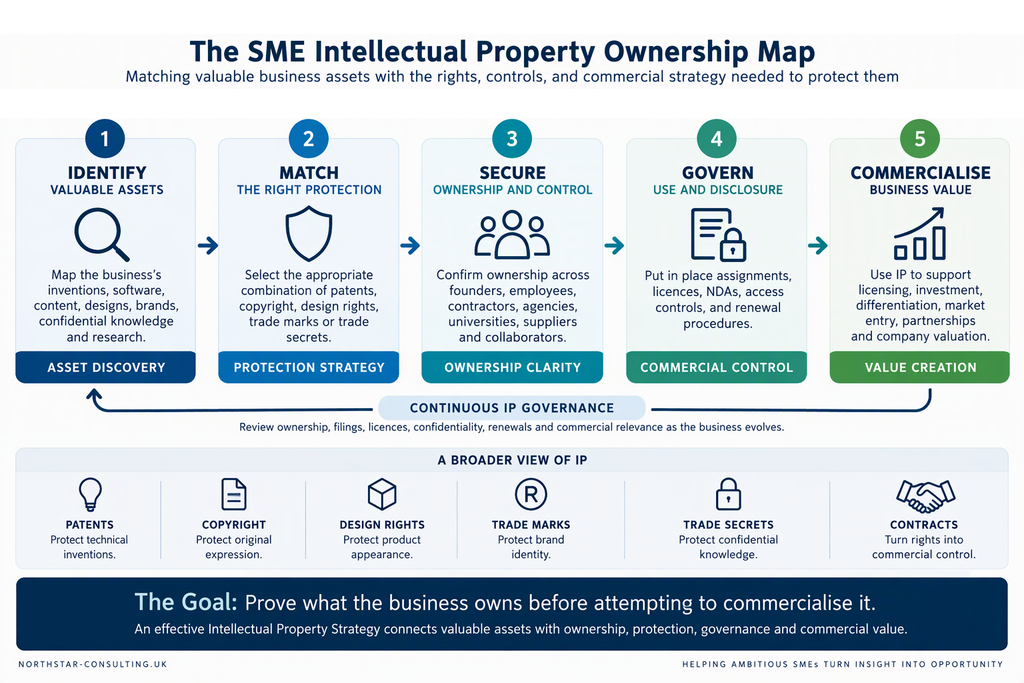
The SME Intellectual Property Ownership Map
An effective Intellectual Property Strategy extends beyond registering individual rights. SMEs must first identify their valuable assets, select the appropriate protections, establish ownership, control their use and connect them with commercial objectives. The SME Intellectual Property Ownership Map below presents this as a continuous process, linking asset discovery with protection, governance and value creation.
Patents: Protecting Technical Inventions
A patent grants time-limited rights over a qualifying technical invention. It may protect products, processes, systems, materials, and functional improvements that meet requirements concerning novelty, inventive step, and industrial application.
Patents can help SMEs secure exclusivity, attract investment, negotiate licences, and support technology transfer. They can also convert technical knowledge into identifiable intangible assets during fundraising, commercial due diligence, or acquisition.
However, applications are normally published, helping competitors study the invention and potentially develop alternatives outside the claims. Protection is also territorial, while drafting, international filings, translations, renewals, monitoring, and enforcement can become expensive.
A UK application must describe the invention and include claims defining the protection sought. Applicants normally have 12 months after their first filing to seek overseas protection while claiming the original priority date. Missing that period may result in losing the priority claim.
From 1 April 2026, an online UK application costs £75. This is only the initial official fee. Renewal payments begin in year five and rise from £90 to £810 by year twenty.
SMEs should prioritise patents when technical novelty supports revenue, investment, licensing, or meaningful exclusivity. Where secrecy can be maintained and reverse engineering remains difficult, trade-secret protection may offer a better alternative.
Copyright: Protecting Original Expression
Copyright protects original creative expression. It can cover software, written content, research publications, photography, illustrations, videos, music, presentations, training materials, and website content.
Copyright protects how an idea is expressed, rather than the underlying idea, method, business model, factual information, or functional concept.
In the UK, copyright arises automatically when qualifying work is created. No registration or official fee is required. This makes copyright accessible to SMEs and commercially useful for software licensing, publishing, digital distribution, franchising, training, and recurring content revenue.
Automatic protection creates an evidential challenge. Businesses should retain dated drafts, source files, version histories, contracts, and creator records. These materials help demonstrate when work was produced and who owned it. Copyright guidance recommends maintaining suitable evidence of creation and ownership.
Ownership presents another commercial risk. Independent developers, designers, photographers, and agencies normally retain copyright unless a written agreement assigns it. Payment alone does not transfer ownership.
For example, paying for a website does not automatically transfer every right in its code, copy, images, and video. Contracts should define ownership, permitted modifications, future migration, sublicensing, reuse, and access to source files.
Copyright should form part of an intellectual property strategy wherever an SME creates software, content, documentation, media, or research publications. The priority is not registration. It is proving creation, securing ownership or sufficient licensing rights, managing permissions, and controlling commercial use.
Design Rights: Protecting Product Appearance
Design rights protect aspects of a product’s appearance, including shape, configuration, colour, materials, texture, and ornamentation. UK unregistered design right primarily protects the shape and configuration of three-dimensional products. It may last for ten years after first marketing or 15 years after creation, whichever expires first.
Supplementary unregistered design right protects two-dimensional and three-dimensional appearance for three years after qualifying public disclosure. Registered designs provide clearer and potentially longer protection. They can protect a whole product or one of its parts, subject to requirements concerning novelty and individual character.
Design protection can benefit SMEs operating in furniture, fashion, packaging, jewellery, consumer products, industrial components, and digital interfaces. However, design rights do not protect technical functionality in the same way as patents.
Ownership must still be secured. Independent designers normally own commissioned designs unless a written agreement transfers the relevant rights. SMEs should therefore settle ownership, licensing, adaptation rights, and international filing responsibilities before work begins.
Trade Marks: Protecting Commercial Identity
A trade mark protects a sign distinguishing one business’s goods or services from competing offers. It may include a name, word, logo, slogan, shape, colour arrangement, or sound.
Trade marks support customer recognition, licensing, franchising, e-commerce enforcement, distribution, and international expansion. However, registrations are territorial and specific to defined goods and services.
The UK uses 45 internationally recognised classes. Classes 1 to 34 cover goods, while classes 35 to 45 cover services. Class selection should reflect current activity and credible growth plans.
Separate word-mark and logo applications can offer greater flexibility than one combined filing. The appropriate structure depends on how the identity will be used, licensed, and enforced.
From 1 April 2026, an online UK application costs £205 for one class, plus £60 for each additional class. Renewal costs £245 for one class, plus £60 for every additional class.
Before international filing, SMEs should assess pronunciation, linguistic meaning, cultural associations, domain availability, local competitors, and earlier rights.
Intellectual Property Strategy: Trade Secrets, Contracts, and Licensing
An effective Intellectual Property Strategy extends beyond registered rights. SMEs also need controls that protect confidential knowledge, establish ownership, and determine how important assets can be used commercially.
Trade secrets may include formulas, algorithms, technical processes, pricing models, customer information, and supplier knowledge. They require no registration or disclosure, but protection depends on keeping the information confidential. Restricted access, secure systems, staff training, supplier controls, and employee exit procedures are therefore essential. NDAs support these measures, but cannot replace consistent operational discipline.
Contracts define who owns existing and newly created intellectual property. They also govern access, modification, confidentiality, licensing, transfer, and commercialisation. Payment alone does not transfer ownership, so contractor and supplier agreements should contain clear written assignments where the SME expects to own the resulting rights.
Licensing allows businesses to generate income or enter new markets without surrendering ownership. Agreements should define territory, duration, exclusivity, royalties, performance obligations, quality standards, and termination rights. Research partnerships require additional care, particularly where several organisations contribute existing knowledge or create new results. The UK Government’s Lambert toolkit provides model structures for university and business collaborations.
Contracts cannot replace registered protection against third parties. However, they determine whether an SME can control, adapt, license, transfer, or sell the assets supporting its revenue. A proper IP roadmap should therefore connect registrations with confidentiality, ownership, licensing, renewals, and enforcement.
Intellectual Property Strategy Begins with Ownership Clarity
An effective Intellectual Property Strategy must show what an SME has created, who owns or controls each asset, where protection applies, and how those rights support commercial value.
Every SME should therefore maintain an intellectual property ownership map. This should record important assets, creators, owners, applicable rights, territorial coverage, licences, confidentiality controls, renewal dates, and enforcement responsibilities. It may reveal that an agency owns the company website, a founder controls a trade mark personally, or a supplier retains rights in an essential design.
These gaps can affect licensing, fundraising, commercial due diligence, international expansion, and company valuation. An SME cannot confidently commercialise, finance, license, or sell an asset until it can demonstrate ownership or sufficient control.
A strong Intellectual Property Strategy connects registrations with contracts, confidentiality, licensing, renewals, and operational governance. The ownership map provides that connection, helping leaders identify vulnerabilities before they restrict growth or investment. Ultimately, intellectual property is not simply a record of registered rights. It is the commercial architecture governing the assets that create revenue, differentiation, and future value.
Build a Stronger Intellectual Property Strategy with Northstar Consulting
Northstar Consulting helps ambitious SMEs identify which knowledge, creative assets, technical capabilities, and brands support meaningful customer value. This commercial perspective connects intellectual property with innovation strategy, market positioning, commercialisation, and investment readiness.
Through our market research services, we help businesses establish where their technical, creative, and brand assets create genuine market differentiation. Our reports and strategic insights provide further evidence on innovation, commercialisation, changing markets, and emerging opportunities.
Northstar Consulting helps SMEs turn valuable ideas into defensible propositions, clearer ownership priorities, stronger commercial readiness, and scalable strategic architecture.